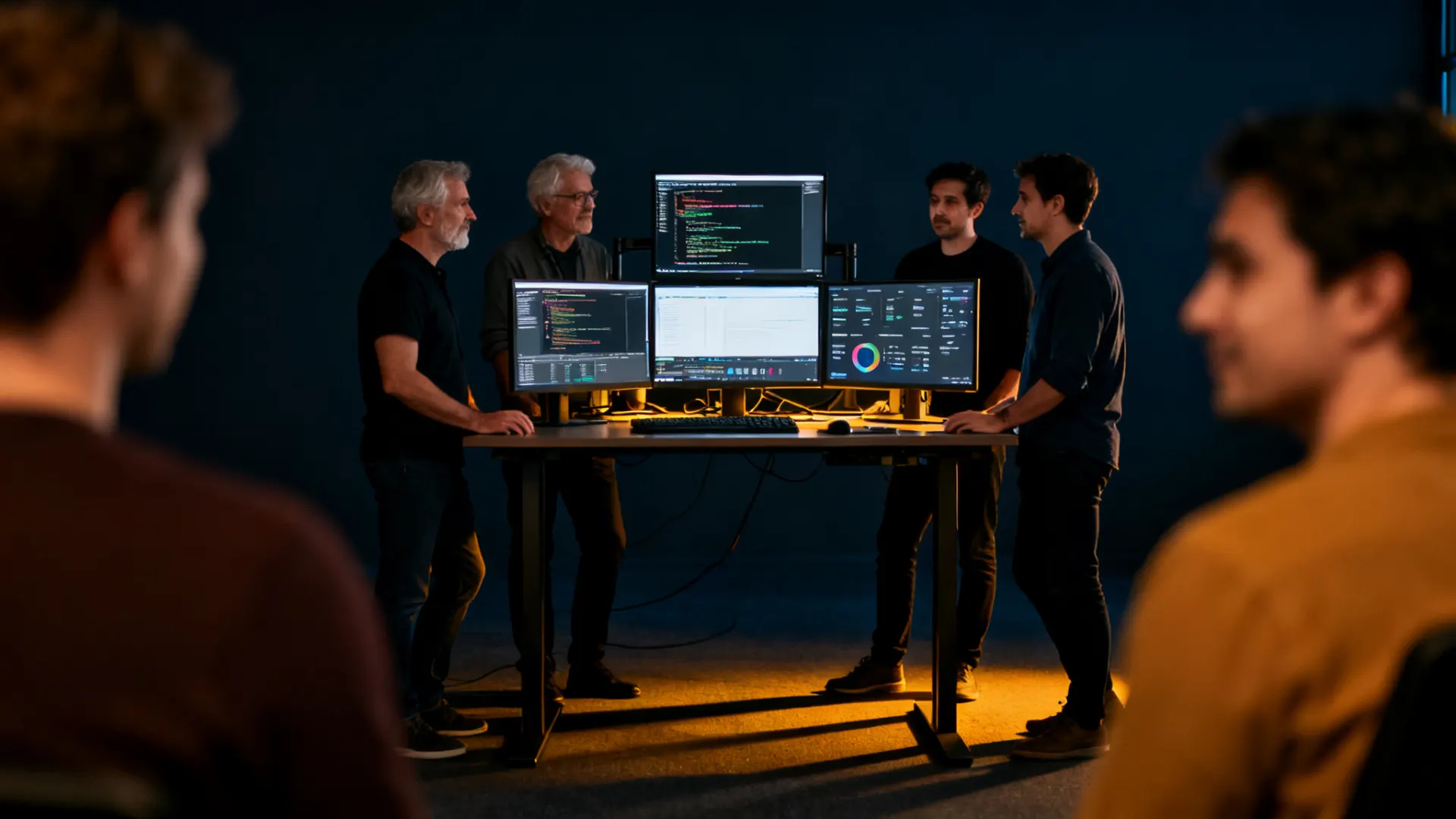
AI Pods
AI Pods. A decade of software product engineering, now amplified by AI.
AI Pods turn important business opportunities into production-ready, AI-enabled software products, faster and at a different cost structure. Experienced engineers bring the judgment and accountability. AI multiplies their speed. Retail and e-commerce, health tech, enterprise software, construction, logistics, manufacturing: if your business runs on software, a pod can build it.
How a pod works
Why we can deliver it.
We bring more than AI tools: the engineering experience to turn AI's potential into production-ready products and business outcomes.
01
Senior talent
Engineers who understand architecture, systems, products, and enterprise environments. They own the decisions AI can't make.
02
Disciplined delivery
Our AI Pods delivery framework takes ideas from prototype to production with quality and accountability: written specs, review gates, and testing built in.
03
AI leverage
AI agents and tools across the whole lifecycle, from definition and architecture to test and deploy, for speed, output, and experimentation.

Who's in a pod
People, process, and AI, in one team.
A traditional pod was people, process, and technology. We've run that model for more than a decade. An AI Pod is people, process, and AI: the same accountable senior team, with AI multiplying what it can deliver.
- Tech lead and solutions architect
- Senior backend and frontend engineers
- Product and project management
- UI/UX design
- QA and DevOps engineering
- Subject-matter experts for your stack
- AI agents and tools working alongside the team
Not vibe coding
Vibe coding is a technique. An AI Pod is a delivery model.
| Vibe coding | AI Pod | |
|---|---|---|
| Who it's for | Individuals, founders, and small teams | Companies with significant software initiatives and defined business outcomes |
| How it works | AI generates code through prompting and iteration | AI embedded across the lifecycle, with engineers accountable for every decision |
| What you get | Rapid prototypes and experiments | Production-ready software and AI-enabled products tied to measurable outcomes |
| Where it breaks | No architecture, governance, or security for production | Built for production from day one |
What you can buy
Three ways to use an AI Pod.
Build a new product
Turn a product idea or market opportunity into working software.
- Digital marketplaces
- New software platforms
- AI-native products
- New customer experiences
Accelerate an existing product
Move an application, platform, or backlog faster.
- Faster feature delivery
- Legacy modernization
- Platform extensions
- Engineering throughput
Build AI-native capabilities
Embed AI into your products, platforms, or customer experiences.
- AI-powered features
- Search and recommendations
- AI-enabled vendor and partner tools
- AI-driven user experiences
Case studies
What We've Built Recently with Our AI Pods
A major retail brand
An AI-native marketplace, live in 90 days
Nine months of vibe coding had produced a marketplace with no path to production. Our AI Pod built the core platform, the product, and its AI capabilities, and took it live in 90 days.
Read the case →Healthcare technology (HIPAA)
A secure foundation for a regulated platform
A pod built the HIPAA-grade core and order-intake product for a health-tech platform, with human review on every change that touches protected data. It led straight to a second phase.
Read the case →Enterprise cloud platform
A new AI product, without derailing the roadmap
An embedded pod built a multi-provider AI control plane under the client's own governance, while their core team stayed on the main platform.
Read the case →How you buy
Prove. Ship. Scale.
Start small, on a real problem. Scale once you have seen the speed and quality on your own product.
Prove
A focused proof of concept on a real business problem, built to production standards from day one.
Ship
The proof of concept goes live, so you see our speed, quality, and economics on your own product.
Scale
The pod becomes your AI-enabled engineering capacity, across one project or several.
Questions
What founders and CTOs ask first.
Isn't this just vibe coding?
No. Vibe coding is a technique for fast prototypes. An AI Pod is a delivery model: senior engineers accountable for architecture, security, and quality, with AI embedded across the lifecycle. Our retail marketplace client came to us after nine months of vibe coding that never reached production.
How is this different from hiring developers?
You get a complete senior team that has worked together, plus a delivery framework built for AI. You don't hire, manage, or train anyone, and you don't wait for a new team to come together.
How do we start?
With a production-grade proof of concept on a real business problem. Once it's live and you've seen the speed and quality, the pod can scale into ongoing capacity.
Who owns the code?
You do. It runs on your infrastructure and it's documented so your own team can take it over.
Next step
Have a product to build?
Thirty minutes with José. Bring the product idea or the build that stalled. You'll leave knowing what a pod would ship, and how fast.